Showing posts with label Freewheelin'. Show all posts

Sunday, August 24, 2008

Bob Dylan Song #26: I Shall Be Free

It's hard not to like the fact that Dylan, as a capper to this fantastic album, slotted in "I Shall Be Free" over any other songs, sending off his album on a goofy, funny high note (and completely taking a left turn from the title, which suggests a "We Shall Overcome"-type hymn). "I Shall Be Free" sounds like it was recorded late one night, probably with some liquid courage, and not quite fully formed - you can hear Dylan pause at points, taking a dipper into his stream of consciousness, and coming up with Anita Ekberg and Willie Mays to flesh out some of the odder passages. Even for an album with a certain looseness (as previously mentioned, "Blowin' In The Wind", of all songs, has a brainfart that came perilously close to ruining the take), "I Shall Be Free" takes the cake, as Bob hoots and hollers at certain points and has occasional moments where he nearly busts out giggling. Thankfully, this song actually encourages that kind of loose ambiance, and the released take is a little richer for it.

"I Shall Be Free", in a lot of ways, is as dated a song as any on this album, which isn't the insult you might think it to be. After all, so much music ends up dated to begin with, even great songs tend to have elements that place it squarely in a certain era; think of Yes' "Owner of a Lonely Heart" and the wacky synthesizer noises plucked directly from a Janet Jackson album. And think about the context of this song - in an album stuffed to the brim with timeless, age-defying music, there are certainly going to be songs that slip through the cracks. You hear "I Shall Be Free", with its cultural references - not that MLK Jr. and Bridgette Bardot are dated references, but as they were uppermost on Bob's mind, it tells you pretty easy what year his mind was in - and its freewheeling prose (sorry, had to do it - I couldn't quite get past the album, could I?), and it's impossible to think of this song as anything other than a song of the 1960s.

It's interesting to note, though, that even for a song with this level of spontaneity, Bob still measures a certain amount of care and songcraft, making sure the song doesn't sound like a tossed-off piece of fluff. His eye for social mores still remains sharp, like the verse where he talks about a politician that "loves all kinds-a people", while eating different foods of ethnic nature (including chitlins - is that much different from current-day politicians trying to glad-hand minorities by adopting their various customs?). Ostensibly an off-kilter love song, Dylan inverts the traditional man-woman relationship by making him a drunken goon and her a rough-and-tumble lady that wears the pants and earns the checks (as a folk singer - now there's an audible wink to the audience if I ever heard one). He even manages a raunchy joke, where JFK asks him how to "make the country grow" and Bob rattles off the names of famous actresses, promising "country will grow!". Or, at least, I assume that's a raunchy joke; maybe my 21st century filthy mind is hearing something that isn't there. For my sake, let's hope not.

You never hear songs like this anymore, which also adds to the dated aspect, but speaks just as much to the ways that songwriting has evolved and changed over the past 40 years. Outside of, say, Weird Al or somebody like that, the art of humorous songwriting has more or less vanished since the 60s and 70s; this may or may not be a bad thing, but it's certainly something that has occurred. Part of it is our shifting tastes in music; after all, you also don't hear party records, or Motown-style pop (which saddens me greatly), or spoken-word records like Cassius Clay's album of poetry (which has its own whimsical cadences and language, almost like Dylan, to be honest). Part of it is the fact that songwriting, as it has matured from "I Wanna Hold Your Hand" to more confessional and broader based songs, tends to squeeze out the funnier elements in lyrics, simply because humor often doesn't belong there (Frank Zappa tried, with wildly mixed results). And part of it is simply that it's hard to write a song like "I Shall Be Free", especially if you're actually trying. They say that for actors, drama is hard, but comedy is much harder, due to the inherent nature of both genres - what makes us cry is often universal, but what makes us laugh is far less so. Any singer worth his or her salt can tug at our heart strings, but making us chuckle is a much tougher proposition; you can't really blame them for not bothering.

"I Shall Be Free" isn't a Dylan classic by any means, but it's a hoot to listen to, and a worthy choice as closer to the pinnacle of his acoustic period. After dealing with some weighty issues, taking us down highways of grief, of anger, of heartache, and of darkness, Bob decides to loosen up and show us that at the end of the day, he's got a smile on his face. The irony is that, come a few short months and a lifetime of progressive fame later, that smile is wiped clean off his face. Just take a look at his album cover.

And that's it for The Freewheelin' Bob Dylan! Thank you so much to everybody that's reading and sticking with the blog - I hope that I sufficiently brought up enough interesting issues to do justice to an album that consistently asks its listeners to think, ponder, sympathize, and simply use the 10% of our brains allotted to us. In a few days, I'll be starting with The Times They Are A-Changin', an album of starkly different mood and many different themes; it isn't considered Dylan's "issues" album for nothing. I hope you'll stick around for that, as well.

To close things out, I'm simply going to paste the cover to The Freewheelin' Bob Dylan, as beautiful and just plain cool an album cover that's ever been created. It's a genuine work of art, and it seems like a fitting way to end my Freewheelin' series. Thank you all again, and see you in a few days!
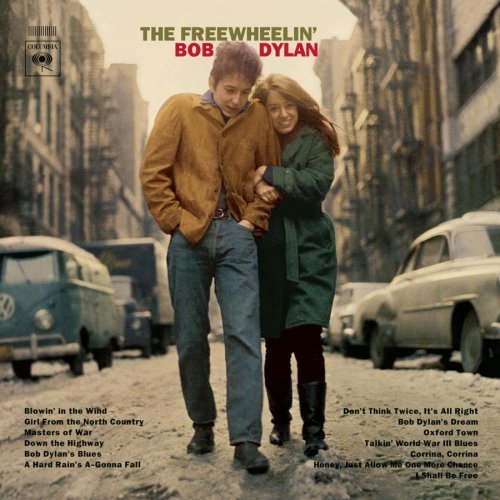
Read more!

Stumble Upon Toolbar

Thursday, August 21, 2008

Bob Dylan Song #25: Honey, Just Allow Me One More Chance

A companion piece, in a way, with "Corrina, Corrina", even though the two songs are rather different in tone and in execution. Dylan basically took an old blues song, threw out everything except the choruses, added some new lyrics, and threw in not one, but two harmonica solos into the mix. Really, it's incredible to think that this was a serious contender for the album, let alone the penultimate song; at 2:01, the song barely has enough time to register before "I Shall Be Free" brings Freewheelin' to a close.

If "Down the Highway" sounds like it could have been on Bob Dylan, "Honey, Just Allow Me One More Chance" sounds like it IS from Bob Dylan and somebody just went ahead and stuck it on here as a prank to see if anybody would actually notice. Dylan's unnaturally guttural, exaggerated vocals, muted throughout the album, pop back up here, which suggests that Dylan himself isn't taking the song that seriously. He punctuates the tune with little "woo-hoo!"s, lets out a laugh in the final verse, and basically sounds like he's having himself a whale of a time. Hell, the harmonica isn't even in tune. The song comes across as a studio toss-off that Dylan played in between takes of a better song and, out of his own puckish sense of humor, decided to slot onto the album at the last second. The fact that it was actually earmarked for a year for the album really feels all the more remarkable.

This leaves me, then, at a quandary for discussion - obviously I'm not going to leave any track behind, no matter how insignificant, but there are only so many avenues to go down for a song like this, and all of them have been traveled. Bob used an old song as the template for this one? Try at least 3 different other songs on this album alone. How about the fact that the inclusion of this tossed-off song, the product of at least one Freewheelin' session, displays the fractured nature of the year-plus that resulted in the album? Just got to that on the previous song. Hell, I even had to mention how this song, like "Down the Highway", bears a closer resemblance to Bob's first album than the album it's currently on.

If there is one new thing to take away from this song, it is the simple fact that, for the most part, a major-label artist is simply not going to get away with this today. There are plenty of indie artists that have no problem slotting something as light and inconsequential as this song onto their albums, mainly because most indie bands still have respect for the album as a concept and enjoy making the songs thereon sound like an organic whole, rather than the collection of 3-4 single and filler an LP of, say, 1958 would probably contain. Major-label artists, on the other hand, have more pressure upon them to write songs that leave more of an impact, that have more substance to them, and feel more important than "hey, we messed around the studio one afternoon, check this out!". And, when you consider just how brutal the music industry is now, how important mp3s and single songs and getting your music passed around is, who wants to waste a precious album or EP track with a bit of fluff? That sort of stuff goes on your b-sides collection in 15 years, buddy.

"Honey, Just Allow Me One More Chance" speaks to a different era of music, when the concept of music as product wasn't quite as fully formed, and when artists weren't totally preoccupied with making sure an album was all killer, no filler. Even the greatest albums have their lesser songs, and songs that only fans would love, but most "greatest ever" albums don't have this sort of song on there, one that practically begs for outtake status. And it's not necessarily a good thing, as much as it's not necessarily a bad thing. It's just there, just a song to fill a groove on a record side, a brief shot before the closer. Nothing wrong with that, is there? Read more!

Stumble Upon Toolbar

Tuesday, August 19, 2008

Bob Dylan Song #24: Corrina, Corrina

It speaks a lot about an album like Freewheelin' that a song like "Corrina, Corrina", a gentle pining love song from the 1920s recorded with the barest bones of a band (light drumming, a soloing electric, and bass), feels like a major departure from the rest of the record. In its own small way, really, it IS a departure from the rest of the record; that speaks even more to the internal universe Freewheelin' had created throughout. Obviously, the mere fact that more than one instrumentalist is performing on the song sets it apart, even though the band is hardly playing rock music and the electric guitar is muted in comparison to the ungodly junk spewing out of AM radio in 1963. The other attribute that makes "Corrina, Corrina" an anomaly is what the song isn't - i.e., an original. On an album almost entirely written by Bob Dylan, he managed to slide in a cover version.

The song itself is fine, if something of a pleasant trifle, but that really doesn't seem to be the point - what "Corrina, Corrina" represents is far more important. The song serves as a window into a tumultuous period of Bob Dylan's life and recording career, a time in which his fate could have gone into any number of different directions, all of them wildly different from each other, and all of them interesting in their own ways. In that regard, "Corrina, Corrina"'s historical importance is hard to overstate. It is the key to what Freewheelin' could have been, and very nearly almost was.

As anybody that's been reading this blog already knows, Bob Dylan was an album almost entirely consisting of cover versions, hand-selected to show off the wide range that Dylan as folk interpreter could operate within. Once that album had flopped, it's entirely understandable for both Bob and Columbia Records to be a little skittish about what to do with Bob next. After all, he was still under contract as a recording artist, but his album had sold terribly and the threat of moving Dylan to a lower-ranking Columbia-owned label loomed very large indeed. And, at that point in Bob's career, he didn't have the same cache as other established songwriters, let alone his own catalog of songs to record an album with. It's no wonder that even though John Hammond had decided that he was committed to making Bob a star, there was no set direction to take his second album towards.

It seems like a sobering thought to consider the album that Bob might have made, had he not had the time to build his reputation further in New York circles and write the strong originals that make the album what it is. The originals that Dylan had written when the first sessions had begun were nowhere near the standard of a "Bob Dylan's Blues", let alone "Hard Rain"; "Sally Gal" and "The Death of Emmitt Till" would hardly have been acceptable substitutes. Without the original material, the album would have been more dependent upon cover versions, which might have worked just fine, but would have suffered for it - does anybody here really relish the thought of hearing Bob perform "That's All Right, Mama" and "Lonesome Whistle Blues"? And then there's the band songs, with the one that did make it and "Mixed-Up Confusion", an original that didn't make it for whatever reason and might have completely skewed Dylan's career in a different direction.

"Mixed-Up Confusion" we'll get to another time, but we still have "Corrina, Corrina" to serve as a small reminder of just how remarkable the sessions for Freewheelin' really were, and how what could have been a mediocre-to-decent album morphed over the span of a single year into one of Dylan's benchmark albums and one of the best albums of the 1960s folk music movement, an album that inspired The Beatles and broke Dylan huge in Great Britain (a year after its release, which will become much more important down the line). History is made up almost entirely of forks in the road, splitting off into new and different forks, branching outwards and outwards into eternity, and we never get to see what would've happened if a different branch would've been taken and if the fork had gone left instead of right. Considering the way that Bob's career turned out, I think that turn in the road worked out just fine. Read more!

Stumble Upon Toolbar

Sunday, August 17, 2008

Bob Dylan Song #23: Talkin' World War III Blues

(1)

It's funny, living in an era of constant fear of terrorist attacks,with the goofy color alert system and Al Qaeda still being hunted across the globe, to think about the very concept of a World War III, an all-encompassing war that could destroy the entire human population. If you think about it, that concept is an old one - after all, we're a full 3 generations away from World War II, and 2 generations away from the Cuban Missile Crisis (which almost certainly helped inspire this song). Even the original concept of World War III - the nuclear annihilation scenario that played out in Dr. Strangelove - originates from the mid-50s and early-60s and was still on many peoples' minds in the 1980s. Today, the fear is still there, but it isn't the same overwhelming fear that weighed on minds the world over as the USSR and USA stared each other down year after year.

On the other hand, the concept of war itself has been around for so long - about as long as civilizations have existed - that the more recent fears of nuclear war seem like a drop in the ocean by comparison. Take a nation as young (relatively speaking) as the United States; in over 330 years of existence, the US has fought in at least 6 major wars, countless other skirmishes and "police actions", and any number of top-secret conflicts 99.99999% of us have no idea about. Nations like France and England have been at peace far shorter than they've been at war - the amazing thing about The Hundred Years War is that the name shortchanges just how long that conflict actually was. To quote Donald Sutherland in JFK, "the organizing principle of any society is for war. The authority of the state over its people resides in its war powers". That seems outlandishly pessimistic, but a great deal of truth exists in those words.

We're living in wartime right now, of course - nominally, at least; the conflict in the Middle East hasn't reached our shores yet, even though the 2nd Iraq war was started over September 11th. It behooves the American readers of our blog to think about just how lucky we've been, and will continue to be, in this regard. A grand total of 5 human beings died on American* soil during World War II, as a result of an exploding balloon floated onto the Pacific Coast by Japanese saboteurs. The number of people killed on 9/11 is infinitesimally small compared to the casualties of war over in Iraq, both military and civilian, let alone the civilian casualties of a major conflict like World War II. The bloodiest war America has ever fought still remains, by a massive margin, the Civil War, an entirely self-contained conflict in this country. There's a reason 9/11 stands out - it's one of a very small number of terrorist attacks on our soil. Compare that to any country in the Middle East, or a third-world African nation, or the Pacific drug-trade countries. Our nation is one of the most secure on the planet, we're naturally buttressed by 2 massive oceans and bordered by friendly nations, and our military might is unquestionably one of the strongest there is.

*edited to add: mainland American soil - idjit I am, I did not count Pearl Harbor as US casualties. My sincere apologies.

This probably explains, then, our country's overwhelming fear of war, our national obsession with our security, and our massive complex when it comes to national defense. After all, we are not a country rife with civil war, or teeming with enemy soldiers fighting skirmishes literally from town to town, or controlled by warlords carving up property like a Thanksgiving turkey. And yet our nation has generated gigantic quantities of books, articles, albums, movies, artwork, and anything else you can think of dedicated to war, death, and our fear that another 9/11 or The Bomb or any number of boogeymen might finally come and wipe us off the face of the earth. It's a really remarkable insecurity, when you think about it, and one that my poor little blog simply has no chance of properly distilling into words. Still, it's something to think about - a song like "Talkin' World War III Blues" sounds funny today, and the lyrics are clearly meant to be absurdist, but there's nothing really funny about them when you get down to its very core. It's a song about insecurity, about isolation, and about the fear of death coming at us right around the corner, and it's a damn good thing it's funny, because otherwise it would be scary as hell.

(2)

The interesting thing about "Talkin' World War III Blues" isn't that it is such an absurd song, as much as it's the kind of absurd you don't really expect from Bob Dylan. Sure, there are crazy situations in the song, and the narrator finds himself being chased by shotgun blasts and peeking out from manhole covers and engaging in behavior you just don't see every day, so it's definitely an absurd song in that sense. But what sets it apart is that the absurdness is sung about, and written about, in a way that we all can understand.

What I mean is that the language of "Talkin' World War III Blues" doesn't take the same dreamy, off-kilter tacks that, say, a "Desolation Row" does, where every line is like something Salvador Dali thought about while eating breakfast. Dylan couches his tale in an almost conversational manner, describing things in a way you'd describe them to your friends (well, if you talked to your friends in rhyming couplets). And that, in turn, invites us into the song, allows us to laugh at the punchlines, and to neatly follow his narrator from one nutty turn to the next. We're not left scratching our heads at lines about jewels and binoculars hanging from the head of a mule, or riding a chrome horse with a diplomat who carried a Siamese cat on his shoulder, or even the sky cracking its poems in naked wonder. "Talkin' World War III Blues" is a song we can understand, laugh at, and sympathize with, but it doesn't leave us in awe.

That's not a bad thing, for sure; it's a different thing. Nobody has doubts that drugs had a lot to do with that change in writing style, but that's not to say that Dylan didn't already know how to look at things slightly askew from the rest of us. After all, not all of us walk around with thoughts of a 3rd World War ringing in our heads. That, to me, is what makes Tarantula so crazy - he had so many wild lines and phrases bouncing around his cranium that he couldn't even contain them in his songs, but had to commission an entire book to squeeze some of his brain droppings into. And we'll never even know what was left on the cutting room floor, the stuff too insane to even make it into a book of absurdist poetry. Dylan had that in his head, practically every day from 1964 to 1966, and he spewed it out as many ways as he could. And even after his wild period, there are songs like "Jokerman" and "High Water (For Charley Patton)" that don't embody quite the same kind of absurdity, but still arrange words and phrases in ways that mere mortals have trouble latching on to.

What makes "Talkin' World War III Blues" so cool, then, is that he managed to spew out the images in his head in a way that you or I could understand. I'm never going to be able to properly fathom a lot of the lyrics of Blonde on Blonde (said the man writing a blog about Dylan's work...hoo boy), or properly put into words why a song like "Senor (Tales of Yankee Power)" works much better when you think of Bob's lyrics as another instrument instead of a means to an end like most lyrics are. I can, however, smile at the hilarity of "Talkin' World War III Blues", even while thinking about what the song's really about. It's nice to have that.

(3)

So, as I said in the first part, this is an awfully lonely and frightening song. I mean, it's a funny song - audiences always chuckled when Bob pulled this one out, making it a fan favorite during his all-acoustic period. But there are definite elements in the song that tell us it's not really meant to be funny, but was written that way to save us a lot of grief at figuring out why Bob would write a song bleaker than anything Elliott Smith ever wrote.

Even taking into account that this is meant to be a dream being described, the main thrust of the song is about loneliness and isolation. The narrator, at every turn, finds himself either all alone or rejected by another human being. At the start of the dream, he finds himself all alone in New York, the last man in town. He asks for food and has a gun fired at him. He engages a hot dog vendor in pleasant chat and the man runs away, thinking him a Communist (a very real fear at the time, as the Red Scare was still in full effect - Communist or terrorist, people always need a straw man). Even when he finds a woman, she rejects his pleas for love. In the end, the only human contact he has is with the old telephone operator that tells the time. I mean, that sounds pretty damn desolate to me.

The real punchline of the song, then, is the fact that the doctor has had the exact same dream; that just goes to show how deep and real those fears were back then, and still are today. Dylan saw it then, as clear as day, and as befitting a man constantly ahead of his time as Bob was back then, he put it into words for all of us to hear. He saw our nation gripped with fear, scared of living on scorched earth, terrified of having time enough at last and nobody to share it with. And, rather than drive that point home with a sledgehammer, he chose to tickle us with a feather. That takes a real gift, turning the horrible into humor, and it's a gift not many of us have. On an album that addresses many issues with stark clarity, Dylan knew that occasionally an issue needs to be couched in a stand-up routine.
Read more!

Stumble Upon Toolbar

Thursday, August 14, 2008

Bob Dylan Song #22: Oxford Town

I hate to say it, but I just don't particularly care for "Oxford Town". It's not that I don't think the story the song tells is worth hearing about, or that the civil rights movement wasn't important, or anything like that. My main quibbles with the song are entirely music based - the brevity of the track renders it more lightweight than anything else, and Dylan's lyrics don't particularly fire the imagination the way his better songs do. That's a shame, of course, but sometimes things just work out that way.

It seems kind of strange, considering the number of classics Dylan was pumping out at this time, that Dylan couldn't have roused himself to write more meaningful and touching lyrics for an incident as staggering and meaningful as the James Meredith saga. In fact, the song reads more like a Cliffs Notes version more than anything else; you might think a harrowing saga of a black man being allowed into a Southern university and the racial-inspired riots that followed might merit better lines than "Guns and clubs followed him down/All because his face was brown" or "He come in to the door, he couldn't get in/All because of the color of his skin/What do you think of that, my frien'?". Not exactly Countee Cullen, is it? I'm certainly not saying I can do better, but I'm definitely saying that Bob could, and there's something a little disheartening in seeing that he didn't.

The other issue I have with the song addresses, to me anyway, a wider issue about folk music in general, and specifically Dylan's as well. The issue of topicality in folk music is a thorny one, precisely because topicality tends to become dated very fast, which hurts the impact and power of those types of songs. Something like, say, "Fixin' To Die Rag", which sounded great on stage at Woodstock in the very midst of the Vietnam War, will probably not sound as good coming out of your iPod headphones in 2008. In a sense, the very issue being written about ties the song down, forcing the songwriter to write his lyrics in a tunnel; with only so much leeway, it's a wonder good topical songs are ever written at all. And, again, I'm not saying that there's no worth to topical songs or to the way they summarize and publicize issues that are often difficult to grasp in their totality. What I'm saying is that their very nature prevents them from lasting as works of art, and that the vitality that carries them from their initial release has a very, very short shelf life.

Even Bob Dylan, as great a song writer the folk movement (and the world) ever had, was not immune to this. Take, for example, "Who Killed Davey Moore?", quite possibly one of the worst songs Dylan has ever written. Not only does the issue at hand not have the same vitality today as it did in the early 60's (who doesn't know that boxing is dangerous and that lives are always threatened in the ring?), but Dylan, constrained to the issue and searching for ways to point the finger as forcefully as he can, ends up bludgeoning his listeners with a sledgehammer instead. Many of his other topical songs suffer from a similar stridency that robs them of any real power; it can get painful hearing Bob try too hard. "Oxford Town" has the opposite problem - Bob's not trying hard enough - but it has the same effect; the issue is still potent, but the troubadour's telling of the tale leaves much to be desired.

Dylan's great protest songs - "Blowin' In the Wind", "With God On Our Side", et. al. - sidestep that issue, simply by opting for universality. Universality can be just as hard in writing a song; since you don't have that specific issue guiding you, a songwriter can often devolve into platitudes or wander aimlessly. But Dylan's masterpieces never rely on cliches and always stay right on point, from start to finish. Even when he delves into history, he makes sure to reach far enough into the past that future generations will still understand - after all, World War II isn't ever going to be forgotten, even if James Meredith might be (which is unfortunate, but such is life). Somebody fifty years from now might not care about Emmitt Till or Davey Moore, but they will always be touched by "Hard Rain" or "When The Ship Comes In". It's a fine line between songs with staying power and songs that don't; not even somebody as brilliant as Bob is can be immune from crossing that line.

Side note: Dylan played this song on stage once, in Oxford, MS (coincidence???) during his 1990 tour, making it one of the least likely songs Dylan has ever pulled out on the Never Ending Tour. Quite frankly, he probably didn't have to bother. Read more!

Stumble Upon Toolbar

Tuesday, August 12, 2008

Bob Dylan Song #21: Bob Dylan's Dream

"Bob Dylan's Dream", I would guess, is meant to act as the companion piece to "Bob Dylan's Blues", both in the titles and in the sense of intimacy that comes (in theory) with a song named after yourself. Well, all right, "Bob Dylan's Blues" is far more goofy than intimate, but "Bob Dylan's Dream" fits that description to a T; in its own way, it feels as personal to Bob as "Don't Think Twice" or "Girl of the North Country"; it's certainly more personal than the omniscience of "Hard Rain" or the philosophy of "Blowin' In the Wind". The funny thing is that the titles actually seem misplaced on the "Bob Dylan" songs - "Blues" has the funnier, more abstract stream-of-consciousness lyrics one might associate with dreaming, while "Dream" is darker and earthier, more like a blues song. I know that Dylan framed the song's story in terms of a dream he had, but the dream seems more grounded in reality than the off-the-wall free association of "Blues".

"Bob Dylan's Dream", actually, has closer ties to a song off the debut, "Talkin' New York", than anything on Freewheelin'. Like "Talkin'", "Dream" relates a tale of Dylan's early days in New York, and manages to couch things in a gauzier, less specific tale of hardship and determination to succeed. However, unlike "Talkin'", "Dream" has the distinction of a) actually being a good song, and b) having lyrics that use that vagueness to sound timeless, rather than simply cliched. "Dream" achieves a level of wistfulness and gentle nostalgia that few songs on the debut, let alone "Talkin' New York", can begin to touch - yet another example of the quantum leap in songwriting quality that Bob achieved in such a short amount of time.

What's more extraordinary about "Dream" isn't that it tells a Dylan origin story better than "Talkin' New York" does, but that it actually makes you feel like the nostalgia is warranted, as though he's reminiscing about decades long gone instead of the 2-odd years since Dylan first arrived in the Village. In fact, if you didn't already know the song was about Bob in New York, you could easily believe it was about his early days in Hibbing - or, I guess, whatever city Dylan told people he was from in those days. Starting with a typical hard-road cliche ("while riding on a train goin' west"), Dylan spins a yarn about having few friends, living a simple life of poverty, and yet overcoming hardship with the help of his companions. Even if it was all made up, it sounds all too real, and very easy to relate to. How many of us haven't had to lean on our friends in hard times to bring us happiness?

And, lest we forget who Dylan's great mentor was, the final verse brings home the real message of the song. Dylan says he'd "give (ten thousand dollars) gladly if our lives could be like that"; i.e., riches, fame, and success means nothing compared to simply being with good friends and laughing the night away. Lest we forget how powerful the pull of nostalgia is, there's Bob's reminder - and, by extension, an affirmation that the simple life is what really means the most, when you get down to it. You'll have to excuse the fact that I'm using cliches here; Dylan's a bit more poetic in his nostalgia, as you would expect.

But it's that declaration that no amount of money is worth those good times, the ones that have burrowed deepest into his heart and brain, that keeps Dylan tied in to the old folk music movement, where most musicians didn't have much more than a few dollars in their pocket, but still had their friends and their music. That idea, sadly, isn't always true - the good times were never as good as we think they were, and there's a certain point where money and success can buy away a lot of nostalgia and memories. We like to pretend that's not true, and yet we know deep down that it is. It's damn hard to be successful and not turn into an asshole, or turn your back on your less successful past, and the few celebrities that manage to hold on to their past deserve a mountain of praise for doing so. They say you never leave behind where you came from, and more often than not it's not for lack of trying. Maybe that's what Dylan meant when he named the song the way he did: the real dream is that our past was nothing but good times, where the future only exists in an abstract sense, where the nights of song and laughs never end, and where the world we live in is confined to a single room, free of responsibility, debt, and sorrow. Read more!

Stumble Upon Toolbar

Sunday, August 10, 2008

Bob Dylan Song #20: Don't Think Twice, It's All Right

(1)

About 7 or 8 years ago, when I was a young lad attending school in Ann Arbor, I was going through something of a rough patch with somebody that I cared very deeply about. That rough patch weighed very deeply on me; away from my Virginia home and something of a shy kid, I leaned on my friends in VA for support and uplift in mood, and my mood had been severely affected by the problems I was having with this friend (a female, for the record). Pained by what I felt was a raw deal I was getting, I had what can only be considered a brief loss of mental faculties and began devising ways of gaining revenge on this person that was hurting me emotionally. Not having quite matured in a way I'd have liked, I didn't bother to consider why things had taken such a turn; after all, it was MY feelings being hurt, and she had to pay for my grievances.

Then I hit upon an answer - the sort of answer that you only see in bad Hollywood films (and, occasionally, even a good one). The next time I was home, I would invite her to one of the open mics I occasionally played, since I knew that she enjoyed my singing and guitar playing. Then, once she was there, I would SLAM her on stage with a song that let her know that not only had she broken my sad bastard heart, but I had gathered up and reassembled the pieces, and I was ready to move on, so take a hike, sister! I deliberated long and hard on the song; finally, I settled on a tried and true classic: yes, I decided I'd play "Don't Think Twice, It's All Right". My Dylan fandom had reached its peak in this time, and (like so many others before) I'd had the experience of Dylan putting my feelings into a song and expressing them far better than I could ever hope or dream to do. So "Don't Think Twice" seemed like the logical choice.

I never did this, thank God; my sense of propriety reaffirmed itself, and eventually the friendship righted itself. I'm being as vague as possible here to protect both of us, so suffice it to say that influences beyond anyone's control had caused things to go south (sadly, those influences would recur over and over again, but that's another story). At any rate, I'm glad I didn't embarrass myself in this fashion, because I would have felt quite the idiot afterwards. The funny thing, if you can call it funny, is that I'm sure that I'm not the only person that has had that idea before, and surely that idea has actually been carried out in full. In fact, Elliott Smith wrote an entire song about it ("Waltz #2 (XO)", where the narrator sings a karaoke song laced with meaning in the presence of his ex), and you can feel the hurt in his voice as he sings it, like he's a few beer bottles away from heading to his local bar and doing that very thing.

There's something about the dramatic gesture that speaks to all of us; after all, why else would Hollywood bother to stick them into films unless we didn't see them and go "my God, how great was that?" Even though most of us would never have the temerity to hold up a boom box like John Cusack in Say Anything..., we all wish that we've had the idea and we all believe that, were we to pull that on somebody, it might actually work. After all, what woman or man wouldn't be just a little touched by something so grand, so insane, so obviously impossible to succeed that they wouldn't just melt like butter? It works the other way, too - there have certainly been days where we've wanted to cold-cock our boss, or heave a computer out the window, or take a baseball bat to the machine you're working on. We all have impulses to do crazy things in our lives, because we are conditioned to want to do crazy things.

We don't do them, of course, for many reasons, not least of which is the fact that they simply never work. Real life is not Hollywood, of course, and people just are not willing or able to overstep the bounds of cultural decorum and do something insane, no matter how much the impulse is there. And that's a good thing, too - let's face it, our real lives are not lives built for craziness. Most of us follow the same path as everyone else; birth, school, work, retirement, death, and maybe if we're lucky we make a little money, find a partner that loves us, or fulfill childhood/adult dreams we have. The grandest gesture I have ever seen, in my own real life, was when my best friend said "I do" at the altar, willfully hitching his own life to somebody else's. In this world of ours, that is grand enough, isn't it?

"Don't Think Twice", in its way, is the grand gesture many of us have wanted to make at some point; the ultimate kiss-off, the best way to say goodbye to a relationship that has run its course. That Dylan managed to do it at the age of 21 is most amazing of all; most of us at age 21 probably haven't managed to expel the "song/poem/artwork of agony" phase to describe romantic-driven torment, and here's this guy that did it better than 99% of us ever could in the very first year of legal alcohol consumption age. We may never know who he wrote that song for, but I don't think it's a stretch to say that as much that song must've hurt that woman when she first heard it, in a small way she had to have been just a little flattered. And, thankfully, Dylan didn't feel the need to sing it through a megaphone outside the building that woman worked at while a crowd gathered around him and cheered at the end.

(2)

It's interesting, with the benefit of hindsight and a few years of maturation, to realize that "Don't Think Twice" isn't quite the nasty kiss-off we've all thought it is for so many years. The prevailing sentiment could be best summed up by Tim Riley's description of the song as "the last word in a long, embittered argument, a paper-thin consolation sung with spite." And that does sound right, doesn't it? Those wicked punchlines at the end of every verse, the verbal equivalent to a nasty smirk, tend to hammer that point home. It's hard to imagine "we never did too much talking anyway" as any sort of consoling phrase, right?

The thing about that sentiment is that it makes the song entirely one-dimensional; viewed through this prism, "Don't Think Twice" is a constant middle finger waved in the face of a former loved one, a stark affirmation of a relationship not worth the paper the song's lyrics were written on. And, as the young man full of young man anger and young man immaturity I was, it was easy to hear the lyrics and go "yes, this is how I will smite my own ex-beloved!" I'm not ashamed to admit this (well, a little); youth has a funny way of missing out on perspective.

And perspective, to be sure, is what this song is all about. Looking at the song now, what I see is the words of a man whose pride has been wounded, and uses those barbed words to mask a deep and painful hurt. After all, why else would he "wish there was something you would do or say/To try and make me change my mind and stay", unless he wanted the unknown woman to give him a reason to come back? Sure, the jabs and insults are still there, but they come across to the present me as bitter lashing out, the kind of lashing out you do when a relationship has reached the end of the road and both parties involved know that there's no turning back. And even that anger manages to be tempered in places; with the assertion that things weren't so bad and that, at some point, he really did love her, and in that final line of every verse: "don't think twice, it's all right". When all is said and done, no matter what's gone on, there's no reason for hard feelings; it's all right, after all.

Look, the majority of relationships tend to fail; that's just who we are as a human race. The hardest thing in the world is to maintain a romantic partnership, especially one that actually is based entirely on love and not just for economic/citizenship/child-related reasons. Staying with anybody for 2 months, let alone for 2 years, can be a Herculean task. That being said, how many of those failed relationships end so badly that both sides end up with nothing but toxic hatred of the other? Unless somebody murders their partner's relative or blows up their house or something, the odds are pretty good that the relationship's demise comes from something innocuous and entirely common. And, after a period of cooling off, most people realize that things weren't so bad; after all, the downfall of the relationship aside, there had to be some good times, right? Most people know how to move on, and to understand that, in the end, they had a good thing going for a while there.

Perhaps I'm reading too far between the lines with this song and ascribing meaning that isn't there, but I honestly think that there has to be something deeper than "it's been fun, now piss off" with this song. I have no doubt that the bitterness is real; I also have no doubt that there had to be something very deeply ingrained in that relationship to cause that level of bitterness. Casual flings don't elicit that kind of venom; there's a reason one-night stands are so popular. You don't get your feelings hurt from one night stands. You do get your feelings hurt when you're in love. "Don't Think Twice" shows a young man who once had love, lost it, and is doing a very good job of pretending it doesn't matter. I think, if you look hard enough, it's rather obvious that it does.

What makes "Don't Think Twice" so special, then, is that it appeals to both the younger, angrier side of us and the older, more measured side, which is something that isn't always true of music, even great music. How many of us get older and find ourselves not as enamored of the mope-rock that The Smiths and The Cure built their reputations upon? And how many of us listened to, say, Steely Dan or other "cerebral" bands as youngsters? "Don't Think Twice" has something for both of those groups - just take a look at a line like "you could've done better, but I don't mind". The younger group would say "she must've treated him so shabbily - just look at that smartass kissoff! I totally understand what he means!" The older group would smile and say "well, of course - how many of us couldn't have done better at some point in our lives? I totally understand what he means!" And therein lies one of Dylan's greatest skills; the ability to speak to all of us, no matter our age or experience, in one way or another. No wonder this is one of Dylan's most enduring songs; it speaks directly to people of all walks of life, and it always says the right things.
Read more!

Stumble Upon Toolbar

Thursday, August 7, 2008

Bob Dylan Song #19: A Hard Rain's A-Gonna Fall

(1)

"A Hard Rain's A-Gonna Fall" has a very special place in Bob Dylan's catalog, and not just because it's one of his very best songs (and, by definition, one of the best songs ever written). What sets "Hard Rain" apart is that there is, more or less, no precedent or antecedent in his catalog for this song; it is in a league all by itself. Other songs of his wield a similar lyrical power; other songs of his paint pictures as HD-clear in your mind; other songs of his are as catchy on a primal level, benefiting from a chord and verse/chorus structure that sticks to your mind like glue. But very few of his songs manage to combine all of those attributes together into one extraordinary package, as "Hard Rain" does.

There is a very interesting reason for this; Dylan borrowed the structure of an old song for his own. "Lord Randall", a traditional British ballad about a young man who has been poisoned by his lover, utilizes the now-famous question and answer verse structure ("Where have you been all the day, Rendal my son/Where have you been all the day, my pretty one?") to tell the sordid story. The original version, while not nearly as lyrically complex as "Hard Rain", still uses strong and clear language to tell the story engagingly; I particularly like the last verse, where the mother asks what the dying man will leave his lover, and he answers "A rope to hang her with, mother". Amusingly, the song has been adopted before by English, Irish, and American songwriters, changing the darker lyrics to a more traditional "pining for a girl" lyrical device. None of the songs, as you might expect, have the same heft as "Lord Randall" does, let alone "Hard Rain".

The concept of recasting old songs in new lights, one of Young Bob's favorite tricks, has been discussed at length here, but I can't help keeping it foremost on my mind. What it reminds me of, in a modern day context, is the ever-raging debate about sampling in music, and whether or not sampling should be allowed, or if it constitutes legitimate art. A lot of my favorite music contains samples, so my thoughts on the issue will be clear right off the bat; all the same, I understand where the other side is coming from, and it's a debate that's worth considering.

What I would assume is most important to established artists, especially really popular artists, is the issue of recompense for samples of their own music. I do understand that; if somebody's going to build off your own work, why shouldn't you get a piece of their profit? Two of the most notoriously difficult to sample artists are the Beatles and James Brown (at least after he started pressing lawsuits); coincidentally, both were absolutely screwed sideways in business dealings and lost a massive chunk of change that rightfully belonged to them through arcane merchandising and licensing deals that made lots of people that weren't them rich. This is a very hard gulf to breach, and all I can really offer as a counterpoint is that while the songs may belong to the artists in a literal sense, in a cultural sense "A Day in The Life" and "The Payback" have stopped belonging to them a very long time ago. They are part of our public consciousness, and they belong to us and to the rest of the world. We treasure those songs, listen to them constantly, are influenced by them to start bands and write songs of our own, and often use them as springboards to new and different bands and songs. Sampling, in its way, is an extension of writing a new song with the old one in mind; you may be using part of that old song, but it's being directed in a new way. Being paid for samples is all well and good, but it makes me sad when royalty fees reach staggering levels. Those famous artists can afford to let their songs go.

The other major issue, then, is the idea of the legitimacy of using samples to create works of art, and whether the sampler is worthy of praise or scorn. I'd hope that most of you would come down on my side of this, but there might be some that think "how lazy is that - he just took that 'Funky Drummer' break and looped it! What an ass!" when you hear some random rap song. I would hope that the numerous fantastic music that's been assembled from samples would be enough to change your mind. An album like, say, Paul's Boutique would not exist without sampling, and yet the samples aren't just there in lieu of imagination. They are the results of imagination; the Dust Brothers and Matt Dike took God knows how many snippets of just about every form of music you could imagine, assembled them together, and created new, exciting, and vital pieces of music from them. There is a certain amount of theft, of course, but there is just as much an amount of tribute and homage to those original artists being paid. Being able to spot something and sample it in a creative fashion is a skill, and I feel very strongly about that.

To bring this back to "Hard Rain", in a very real sense, Bob sampled that question-and-answer style for his song, more or less down to the very idea of a mother singing to her son (honestly, is there a reason that it's mother/son unless it came directly from "Lord Randall"?), and he took that sample to create a song that is on a whole other artistic level. From that structure, he built a foundation of dazzling lyricism, full of mind-bending imagery, heartbreaking dramatic moments, and a final promise to shed light in the darkness of the world that that blue-eyed son has seen, to sing about the empty hands of the people and the hidden face of the executioner, and to do it all in the face of whatever comes, be it the Lord's pounding rain. He took a piece of the past and recast it in his own way as a piece of the future.

Whenever I listen to sampled music, I often find myself searching out the origins of the samples, and that often leads to my musical vocabulary being enriched and broadened. Mashup artist du jour Girl Talk, for example, slams hundreds of samples into his works, and that leads me to Annie's hyper-modern pop and forgotten classic-rock nuggets like "Gimme Some Lovin'". It's not quite the same here - I severely doubt most people today have any interest in traditional music - but given how much Dylan still loves traditional music, I think that idea might have been wedged somewhere in the back of his mind. It's like "Pretty Peggy-O"; Bob loves it, and he wants us to love it, too. Just remember what Newton said about why he could see further.

(2)

So most of you, I'm sure, have heard the Gaslight Tapes, either through bootlegging or the version sold at, of all the places, Starbucks stores (the Starbucks version is missing seven songs, for reasons not particularly clear to anybody). For those that haven't, you're missing out: Dylan, presumably at a late-hours show in a small cafe in New York, performs a few originals and a truckload of traditional songs, one of which made it on Bob Dylan ("See That My Grave Is Kept Clean") and a couple that should've made it on either of his first 2 albums ("Black Cross", "Rocks and Gravel"). The performances are quite good, of course, but it's the rarity of the material that makes the tapes really essential. And, seeing as the show comes from October 1962, before Dylan's 2nd Freewheelin' sessions, you can see Bob making the transition from the interpreter of his debut to the talented writer of originals a year later.

At any rate, the opening song on the tape is "Hard Rain", which some people attending might have actually heard before (the song was premiered at a Carnegie Hall hootenanny a month earlier), but surely some in attendance hadn't heard. It must've been amazing - those words just pouring first, line after line, leading to that famous chorus that actually builds its own intensity on top of the intensity of the verses performed before. But what's really cool about the performance is that, as Bob sings the chorus, the people in attendance actually begin to join in and sing along with him. Their voices are faint on the tape - the recording system, which picks up Bob's voice and guitar quite well, doesn't catch the audience as well - but still audible, an impromptu backup vocal group for Bob.

What's cool about that, on top of the spur-of-the-moment feel of it, is simply the fact that the audience chose to participate at all. I'm no great shakes as a musician, but a while back I liked to play an open mic at a coffee house/performance venue not too far from where I was living. It was a fun time; there were plenty of good acts every time out, my friends would come by and watch me sing, and there really aren't that many thrills you can have for free than performing in front of a crowd (especially if it's an original you're performing). But, in the end, what made playing those open mics so great was just being able to get up there at all, to be part of something public and shared.

Music, of course, was meant to be performed for audiences long before records and CDs and mp3s and all that; hell, even before sheet music. That was the point - nobody was thinking about selling albums or building buzz for the next tour, just reveling in how great music is and having a good time with some friends. Bill James, the noted baseball historian, actually writes about this when talking about a baseball player who participated in a barbershop quartet - at a certain point, with the proliferation of recording devices and increasingly portable ways to listen to music, the idea of performances like that sort of died away. After all, you've got the CDs, you can hear professional musicians, so why bother singing for yourself or for others?

That's a bunch of crap, obviously; so much of the thrill, the fun of music is making it for yourself, which is why karaoke has gotten so popular (having alcohol to "improve" your performance doesn't hurt, either). Karaoke, along with the more traditional open mics, allows us peons to reclaim music for ourselves, to make noise and sing and all that without fear and with the joy that comes of being around others that love music just as much as you do. That performance of "Hard Rain" captures that spirit incredibly well, and I'm glad that it exists for us to hear.

(3)

A BRIEF, ENTIRELY SUBJECTIVE, AND SURELY INCOMPLETE HISTORY OF "A HARD RAIN'S A-GONNA FALL", AS PERFORMED LIVE BY BOB DYLAN

- 1962: "Hard Rain" debuts at a Carnegie Hall hootenanny set up by Pete Seeger.

- 1963: Shows up a few times, most notably on the Studs Terkel radio show performance and in Dylan's huge Carnegie Hall headlining show.

-1964: Performed on Canada's Quest TV show, or as I like to call it, the "Why The Hell Is Dylan Performing In A Rustic Log Cabin?" show. Video below, just so you can ponder that very question as well (and, I guess, enjoy the performance). As you might imagine, it's a staple of Bob's setlist that year, and shows up in the released (and awesome) Philharmonic Hall show.


-1965: Disappears from setlists; doesn't even show up on the UK tour filmed for Don't Look Back, where his all-acoustic setlists basically erased his (admittedly small) electric output from the public record. Your guess is as good as mine.

-1971: Performing his first United States concert in 6 years, Dylan dusts off "Hard Rain" as the opener for his set at the Concert for Bangladesh, backed by George Harrison, Leon Russell, and Ringo Starr (on tambourine; thanks, Ringo!). The timing's a tad off at times, but the performance sounds very relaxed and comes off great.

-1974: A single performance in Denver as part of Tour '74. Let's move on, shall we?

-1975: I'll admit it - the major reason I put this section together was to talk about Bob's RTR I performances of "Hard Rain". Some of you may remember my little discussion about covers in one of my older posts. Well, this is as extraordinary as you can get; Dylan, by virtue of remaking this song inside out, essentially is covering himself. It's a brave decision, in a way, recasting one of his most famous folk-era songs as a Chicago blues song, complete with stinging slide guitar and a bassline that lopes like the "Keep On Truckin'" guy, and yet it sounds incredibly natural, like THIS was the real version and the acoustic version was the "cover". I'm including the "Hard Rain" from the Waterbury show on November 11, 1975 (one of my top 3 RTR I shows) for your listening pleasure. The sound's not quite up to the standard of the official Bootleg Series CD, but the performance is a cut above; this bastard smokes.

http://www.sendspace.com/file/dn7pmv

ETA: Just found video of "Hard Rain" from the Montreal show (another of my top 3 RTR I shows...the 3rd one I'll leave you all to guess for yourself). To not include it here would be a legitimate crime against humanity. Well, a legitimate crime against you readers.


-1976: Much like the rest of RTR II (as big a disappointment as any of Bob's career), the performances of "Hard Rain" from this tour leave me kinda cold. The band slows the song down, almost to the point of torpor (it's slower than the Freewheelin' version!), fucks up the chorus, and stretches out the "it's a hard rain's a-gonna fall" line in a way that it surely was not meant to. If RTR I was like taking a Ferarri down the Autobahn, RTR II was, for the most part, like taking a Ferrari down Broadway in New York City when the red light pattern is distinctly not in your favor. Performances like this illustrate that perfectly.

-1978: Shows up either as a show-opening instrumental, or as an acoustic version. Usually a welcome respite, as any acoustic version would be, from the overwhelming histrionics of the 1978 world tour.

-1980: Part of the "Musical Retrospective" shows at the end of the year, i.e. Bob's way of saying "okay, I get it, the religious stuff is wearing thin on ME too". I've always liked the 80-81 bands, and they do the song justice here.

-1984: Performed in the acoustic set of Dylan's European tour that ended up being documented on Real Live (it still stuns me that we have a live album of that crappy tour, but we had to wait 30 years for the RTR to get their due). My memory of the tour's sound is admittedly hazy; the Barcelona show's the only one that really stuck with me, to be honest. I'm just still bitter that he didn't tour with his Letterman band.

-1986: The best part of the Dylan/Petty & the Heartbreakers tour this year was the acoustic section, where Dylan would duet with Petty. The version of "Hard Rain" from the Buffalo show is intimate (no small feat in a football stadium) and great.

-1988: It's hard to find a Dylan fan that doesn't like the 1988 tour, especially when he'd bust out the acoustics with GE Smith and play both some of his songs and a traditional or two. "Hard Rain", like just about all the acoustic performances, is beautifully performed and well sung (as fantastic as the electric portions of the 88 shows were, Dylan actually got to sing on the acoustic parts, and he makes the most of it).

-1994: Skipped all the other years just so I could link to the video of Dylan performing "Hard Rain" at the Great Music Experience in Japan, backed by a massive orchestra. All three songs he performed here were fantastic; the strings and added instruments give the song an added heft and help underscore the lyrics. Just watch it, for Pete's sake.


-1995-today: Dylan always gives this song a sort of "elder statesman" treatment in his shows, performing it with gravitas and letting his band solo away (as is his wont for the modern NET shows). The version on Bathed in a Stream of Pure Heat is the benchmark example.

Thanks to Olof Bjorner and his awesome Dylan site for helping with Section 3.
Read more!

Stumble Upon Toolbar

Tuesday, August 5, 2008

Bob Dylan Song #18: Bob Dylan's Blues

And now for something completely different. As a change of pace five songs in, "Bob Dylan's Blues" works quite well - it's jaunty and upbeat, Bob speak-sings in that goofy inflection of his, and he's clearly having a blast puffing his harmonica and working his way through funny, charming lyrics (the best being the final verse: "Well, lookit here buddy/You want to be like me/Pull out your six-shooter/And rob every bank you can see/Tell the judge I said it was all right"). He not only gives out a "Yes!" at the end, but adds a gleeful "woohoo!" as well, as though one exhortation just wasn't enough to convey what a heck of a time he was having. The song's an amusing bit of fluff, two and a half minutes to tap your feet and grin to until we get back to the real classic business.

But there's something else to this song, something that lends the song a little more interest, and it lies in the title of the song - a title that, I'm sure, was not bestowed by accident or arbitrarily. I would guess that Bob WANTED us to notice the title, to take some importance in the fact that a song that mentions the Lone Ranger and Tonto and flits from a smartass love declaration to asking people "watch out so you don't step on me" bears his name in its title. So, then, what's the big damn deal?

Well, what is it that defines the Dylan of the mid-sixties, the one most people know the best, the one that his reputation as some sort of Superman was based on and has rested upon for over 4 decades? It ain't just the fact that he went electric; it's his surreal wordplay, his gift of writing lyrics that looked like cut-and-paste wackiness but flowed from the speakers like magic, and his oddball and oft-hilarious sense of humor. Now, all of those qualities aren't quite there in "Bob Dylan's Blues", but you can see flashes of them, the same way you can see flashes of greatness in Bottle Rocket or in Warhol's first stabs at pop art. And, more importantly, this is the only song on Freewheelin' that actually gives us those flashes - even the classic songs here are more austere and straightforward than off the wall and (why ignore it?) drug-inspired.

What "Bob Dylan's Blues" gives us, then, is the pupating Dylan of the Triumvirate of Excellence, the three-album stretch that more or less secured him lifelong renown even without the rest of his career. This Dylan, unfortunately, would not get to bloom for a few more albums; The Times They Are A-Changin' pushed the austere side of Bob to the absolute limit, while Another Side of Bob Dylan contained a few more flashes but was more of a transition album (in many ways, the ultimate example of a transition album). Of course, "a few more albums" happened within the span of 2 years - it still boggles the mind how quickly Dylan developed between now and Bringing It All Back Home, as quick an artistic development as anybody in musical history. But all the same, that development did take some time, and so we can have a song like "Bob Dylan's Blues" that pointed the way to Bob's eventual transformation, but only with the benefit of hindsight.

It is interesting to think about if Dylan had skipped those last two albums and gone straight to the crazy Tarantula style of lyricism in 1963 (assuming, of course, that it was possible to do that without the years of experience, the crazy happenings that led him away from the path of folkosity, and the pharmacy he carried with him). Would he have changed the rules that early, sparking a musical revolution that taught the world that you didn't just have to sing about holding hands or saving the downtrodden? Or would he have been consigned to the dust bins of history, laughed at as a lunatic, destined to be stuck on one of those box sets I talked about before that compiled the era's forgotten tracks? Would Bob have been shunted aside by Columbia (as they were planning to do before Freewheelin' became a hit), or feted as the next big commercial star (as he was after "Subterranean Homesick Blues" went Top 40)? I suppose, in the end, those questions are academic - but they're fun to think about, and thanks to a song like "Bob Dylan's Blues", that showed a side of Dylan you'd never expect after his debut album, we have a reason to think about them. Read more!

Stumble Upon Toolbar

Sunday, August 3, 2008

Bob Dylan Song #17: Down The Highway

It feels kind of strange, after the last three absolute classics, to get a bit of a respite here; "Down The Highway" is a fine song, but not on the level of the songs that preceded it. In fact, "Down The Highway" (which shows its blues roots a little too blatantly) could have slotted very easily into the first album, without anybody knowing any better. To be frank, if somebody had told me that this was another blues cover, I probably wouldn't have questioned them.

That isn't to say that there isn't some worth to the song being on the album. For one thing, Dylan plays a neat little riff throughout the song, and it's fun to wait for the moment it comes, a brisk strumming followed by a little flourish. If nothing else, it shows just how good Dylan's gotten at the guitar over the past year or so - nothing on Bob Dylan is as complicated as that riff (which isn't THAT complicated, but certainly a step above simple chord progressions). And, if you're more of a blues fan, there's some enjoyment out of counting all the lyrical cliches Bob manages to stuff into 3 and a half minutes, from the repeating A-B verse structure to references to gambling and "my baby" running off. Hell, even the idea of the highway as metaphor for restless traveling was explored in the last album, as a cover no less.

I already did a song comparison in the last post, but it might be a little educational to compare a song like "Down The Highway", which might as well have been Mad-Libs (he uses the phrase "Please don't take away my highway shoes", for the love of Jesus), with something like "Don't Think Twice, It's All Right", which explores similar themes but manages to do it way, way better. They're obviously in different universes lyrically, but one of them manages to be painfully personal, while the other manages to sound similar to a lot of other blues songs. Dylan, still feeling his way musically (even on this masterpiece of an album), apparently hadn't managed to discern why one is a great song and the other one is, at best, serviceable. Then again, he DID include "Don't Think Twice" on the album.

I would say that Bob was stripped for ideas and just threw this baby on to fill a side, but there are enough outtakes and unreleased tunes floating around from these sessions to put that theory aside. Perhaps, then, Dylan just included the song as a tip of the cap to his last effort, to all the blues songs he'd played and drawn inspiration from. What the hell, maybe he wanted to show off that little riff he'd written. Every classic album has a song like this - one that might not be as strong as the best tracks, but helps add to the overall tapestry. "Down The Highway" adds to the tapestry. That's as good as you can say about a song that isn't a classic, right? Read more!

Stumble Upon Toolbar

Wednesday, July 30, 2008

Bob Dylan Song #16: Masters of War

(1)

Just in case anybody was actually wondering, I'm going to make it a point to stay as far away from any discussion of wars, past/present/future, in writing this post. I've never been the most educated human being when it comes to current events (although I try to be, intermittently), and attempting to formulate any opinions that go farther than "war is bad, kthxbai" will only serve to embarrass myself. And, quite frankly, if I'm going to embarrass myself, it's going to be strictly on my opinions on Bob Dylan. So, there.

Instead, let's think about movements in musical history. There is a tendency, when people look back on different eras of modern popular music, to shine a spotlight directly on the cream of the crop and quietly sweep the less interesting/good stuff under the carpet. Even a brilliantly conceived box set like Nuggets or No Thanks! or The Anthology of American Folk Music will tend to focus either on highlights or on lesser-known great songs from these diverse periods of music. You never hear about the crappy bands, the artists glomming onto what's hot to make a few bucks, the groups that get the sound right but don't get the inherent soul that makes a great recording great, the also-rans that help a movement slowly make its way to irrelevance and the great cultural scrap heap.

This makes sense, of course - why would anybody want to dwell on the shit? Take the British Invasion, for example; when you've got classics by The Beatles, The Kinks, the Rolling Stones, The Animals, and any number of great bands, why would you want to listen to some jerkoff who ripped off the chords to "She Loves You" and churned out a brutal piece of chiming-guitar pap? There is enough great punk music out there to avoid any number of idiots who thought three chords, a sneer, and lyrics about hating stuff was enough to put out a 45. There is plenty of forgotten great music out there - just ask DJ Shadow - but there is also a ton of forgotten terrible music out there, and good riddance to bad rubbish.

On the other hand, the ratio of terrible music to good music, like the ratio of just about everything you can think of, slants way towards the side of terrible music. In a sense, that's what musical movements really are: a few vanguard bands pushing things forward, a few good bands making good music, then you've got some one-hit wonders, some bands that don't really make good music but make a lot of money anyway...and then just lots and lots of utter crap. That's why musical movements tend to die; after a while, the dreck overwhelms the quality, and people find something else to start listening to.

The upshot of all this, then, is that you can see how the great bands manage to stay great throughout the years. Every great band, no matter who, are always both of their time and not of their time. Forgive me for making that sound stupidly simple, but I think the point is fair. A band like The Beatles has recorded a lot of songs that sound like the guitar pop of the early to mid 1960s, and then a lot of songs that you couldn't put a finger on, era-wise, if you didn't know The Beatles had recorded them (and yes, there are people that can't immediately recognize every Beatles song ever recorded, if you can believe it). Greatness, amongst other things, lies in being able to transcend time periods, if not outright genres.

This will probably look like an unfair analysis, but I think it's pertinent to the issue at hand. Take a look at "Masters of War" and another famous anti-war song, Country Joe & The Fish's "Feel Like I'm Fixin' To Die Rag". Both songs are ostensibly about why war sucks and is bad. Both songs were performed acoustically, and written in the 1960s. Both of them were inspired by major events of the times - "Masters of War" by Eisenhower's "military-industrial complex" speech, "Fixin' To Die Rag" by the Vietnam War. And both of them became very well-known protest songs of the period, practically talking points for the burgeoning anti-war youth movement.

So why is it that "Masters of War" is still considered a classic and "Fixin' To Die Rag" is consigned to the history bins? Look no further than the lyrics of the songs. "Fixin' To Die Rag" is very, very, very specifically about Vietnam. References are dropped about commies, the Cong, and "Vietnam" is said in just about every verse. Most of the lyrics could apply to other wars, sure, but it's pretty apparent which war is being talked about (if not outright being sledgehammered into your skull). "Fixin' To Die Rag" is a funny, goofy, and even thought-provoking tune - although the very definition of "preaching to the choir" - but basically has no real interest outside of being a period piece today. And that's probably just fine with Joe McDonald.

But what puts "Masters of War" on a different level is the fact that it's being written on a whole other level. First of all, it's not specifically an anti-war song, the same way most anti-war songs tend to be. If nothing else, it's a distant cousin to "My Generation" - a song that points the finger at the elderly, the people in power, that have forgotten what it meant to be young and idealistic, and only know how to destroy and kill and make money. It's not as pithy as "My Generation" is, or as visceral, but the general point is there. The song could've been "Masters of Smoking Tobacco" or "Masters of Pure-Grain Alcohol" and it would've had the same impact, because the sentiments would've stayed exactly the same.

And there is the lasting impact of "Masters of War", the reason its relevance has burned brightly for over 40 years, the reason so many artists have covered the song, and the reason why with every new war somebody (yes, including Bob) takes the song out for another whirl. Is the song against war? Yes, of course it is. Does it feel like it's as much a relic of its time as a "McGovern '72" button or Our Man Flint is? Not by a long shot. "Masters of War" will always be timely, always be pertinent, and always be malleable for whatever time it's in - provided, of course, as long as there are young people to hear its words and believe its message.

Final note: on the "No Direction Home" version of "Masters of War" (from the fabled 4/12/63 Town Hall show), Dylan uttered a quote that might, just might, have some relevance to our current times. Here it is:

I believe in the ten commandments, the first one: “I'm the Lord thy god,” it's a great commandment if it's not said by the wrong people.

(2)

It's interesting to note that Dylan, for whatever reason, felt the need to put a little speed into this song as the years went by. At first, he performed the song more or less as found on Freewheelin', which should be expected. Then, as he moved away from performing protest songs, he put "Masters of War" (a defining Dylan protest song if there ever was one) on the backburner for a while. And on the backburner it would stay, as inferior songs got airings on his tours (I mean, I like "Mozambique" and "Ballad of Hollis Brown" just fine, but they ain't "Masters of War"). Then, for the ill-fated 1984 "Real Live" tour, "Masters of War" suddenly makes a reappearance (ETA: it actually showed up in 1978 and 1981 - I'd totally forgotten about that, mainly because I usually prefer the 78 rehearsals over any of the actual 78 shows and the 1981 shows...well, I'm an idiot sometimes). And it's fast.

I wonder why Dylan wanted to electrify this song. Maybe it's not such a mystery; of his many acoustic songs, this was more well-suited for a full band treatment than most, and the fiery words deserved an equally fiery instrumentation. Then again, Dylan tended to rip off his versions of the song, especially the Interstate 88 "these go to 11" versions, at a quick tempo; the words could get a little lost in the rush. I guess, like most Dylan decisions, it was just his whim; Lord knows I'm not complaining. Just interesting, that's all.

And then, in 1994, Dylan goes acoustic again, in Hiroshima (of all places). The acoustic version, for whatever reason, seems to be a better fit; the tension is more contained, ready to leap out of the amps, as opposed to the electric versions firing off tension like shotgun shells. This time, you can hear every word, every nuance, every subtle expression of anger and frustration. His band, always made up of professionals, gives it a beautiful treatment as well, with expressive acoustic solos bridging the verses and a gently propulsive bassline moving everything along. I seriously doubt Dylan ever thinks about whether or not he should've used a band for his acoustic albums...but if he does, this is probably what he'd have wanted them to sound like.

So with that in mind, here's video of Bob Dylan and His Band performing "Masters of War" at Woodstock '94. The best part of his Woodstock performance, as shown in this video, is that he more or less performs the same set here as he would've in Wheeling, WV - and it rules. Enjoy!

Special thanks to Justin Shapiro for his help on this post.

Read more!

Stumble Upon Toolbar

Saturday, July 26, 2008

Bob Dylan Song #15: Girl of the North Country

Ed. note: As recently as 5 minutes ago, I was planning on combining this entry with the Nashville Skyline version, both because it's the same song (essentially) and because I have a great affection for that version and wanted to jump the gun and write about it. In the end, I decided against it; not only would it be cheating, but there's enough things to talk about for both this and the NS version that I could keep the entries separate. Also, the Freewheelin' version of this song deserves its own post. So there you go.

(1)

Those of you that have seen Citizen Kane will surely remember the "white parasol" speech delivered by Mr. Bernstein, Kane's business manager and greatest admirer, who is important enough to warrant interview but not important enough to be granted a last name. At any rate, Bernstein, in the course of talking to inquiring reporter Thompson, discusses just how powerful human memory is, and brings up a specific example from his own life. One day, many years previous, he was on a ferry about to disembark just as another ferry was pulling in, and he saw a woman on that ferry holding a white parasol. Quoting him, "I only saw her for one second. She didn't see me at all, but I'll bet a month hasn't gone by since that I haven't thought of that girl."

It's a very powerful moment, one often cited as a highlight of the movie. Roger Ebert has stated that it's his favorite scene, even though it has nothing to do with Kane. And I'm not going to disagree - rarely do you get to see a sentiment so universal and beautiful as that one condensed as well as Herman Mankiewicz did for that screenplay. It really doesn't have anything to do with the story proper, but that doesn't even matter.

Regret is an emotion that doesn't get the same billing as some of the bigger ones - love, hatred, anger, etc. And yet it's hard to disagree that regret plays a major part in our lives, and often drives us far more than we would ever admit. Think about parents pushing their kids into sports or God knows what hobbies, or about someone buying a used '72 Mustang because he wishes he'd spent more time with his dad in the garage, or somebody trapped in a loveless marriage and sleeping around in the hope of rediscovering the man that got away. To me, that's why the concept of the time machine holds such interest (other than the desire for wealth and fame); who wouldn't want to go back in time to fix their mistakes, to kiss that girl, to take that job in Italy, or simply to tell someone you know that you loved them?

People often talk about "moving on" and "not looking back", and they're right, of course - the only thing dwelling in the past does is to take away from the present. But the damn problem with the past is that it isn't something abstract, like the future, or continually in flux like the present. It's already happened. It's there forever, both for good and for bad, and will always remain as a reference point whenever you feel the need to think about it. Nobody's life is every really informed by what they might do in 20 years, but everybody's life is informed by who they were 5 years ago. How often can you really just leave something entirely behind, ridding yourself of any physical/emotional/mental evidence that that something ever entered your existence? Hardly ever. It's almost like being an addict - you can get only so far away, but you'll never truly be free, and you have to live with that until you die.

It is the very luckiest of us that can take our past, then, and create something out of it. Whether it's a book, a poem, a painting, a song, or even just a particularly emotion-fraught entry in a journal, the ability to face your experiences head on and bend them to your will is truly remarkable. And, if you're really lucky, that piece of work will become as beloved as the memory you're writing/singing/what have you about, if only because so many of us share those same emotions, the same hurt, and the same desire to go back and either do it different or exactly the same. We all want that woman in the white parasol, and who knows - maybe she likes Illmatic as much as I do.

(2)

Try to follow me on this. Let's say you've got a centuries-old English recipe for chicken noodle soup, passed through generation after generation, learned by only a select few and renowned as a classic, beloved recipe. You teach the recipe to some young kid in New York visiting London, along with a few other old recipes you've learned over the years; he then takes that chicken noodle soup recipe, keeps only the soup base part, and makes a brand new recipe for beef and potato soup, which he then releases to an adoring public. You then teach that soup recipe to another kid from America; he then takes that recipe, combines it with a recipe for dumplings, and releases this new recipe as his own, without crediting the original source. That would probably get your goat a little bit, wouldn't it?

It got Martin Carthy's goat, and I can't really blame him for it. He held a grudge against Paul Simon for three decades, based around "Scarborough Fair/Canticle" being released as an original Simon/Garfunkel composition, instead of a traditional, or even "trad arr. Simon/Garfunkel (at least Young Bob was smart enough to know that racket). For somebody like Carthy, who holds a very deep respect for traditional English music, that had to be a pretty ugly slap in the face. I'm not sure he holds the same grudge for "Girl of the North Country", but that probably didn't sit too well with him either. There's a lot to be said for upholding the past, and Carthy deserves a ton of credit for his stance.

Then again...it isn't Carthy's song, now is it? You can defend something you didn't create as much as you want, but that doesn't change the fact that, at the end of the day, you didn't create it; somebody else did, and unless they're around to take credit for their own work (or, as the case may be, copyright it), that work is free to be used as someone wishes to use it. And it's not as though this is a melody that was written in 1962 and should be protected from that sort of blatant theft. "Scarborough Fair" was written centuries ago, derived from yet another traditional ballad (Scottish - damn those plundering English pigs!), and the melody has been around long enough that nobody's feelings ought to be really hurt if it's used in a different way.

The really amazing thing, to me anyway, is that the melody was actually written by somebody. Doesn't it sometimes astound you that certain melodies weren't just handed down by Moses, but were actually composed by somebody? Surely the Ramones didn't come up with "E-A-D" for half of their songs - somebody had to have thought of that progression long before, right? That's one of the coolest things about music, to me; great strides have been taken in this century, but there was a very long and established history of popular music before 1900, and there are still arrangements and chord progressions from that time being used today. And somebody, maybe sitting in a straw-roofed hut or in the fanciest English castle, had to write those melodies. It's a staggering thing to think about.

(3)

I'm probably not the only Dylan fan that hears the opening of the Freewheelin' version of "Girl of the North Country" and thinks, ever so briefly, of "Tomorrow is a Long Time", one of those great Dylan songs that nobody's really heard of, and a prime example of how often Dylan likes to leave classic songs off his albums, the jerk. The ringing guitar intro is basically picked the same way, made up of the same chords; hell, they were written about the same time, and Dylan just figured "Girl" was the better song to release. And it's not like Dylan doesn't do these sort of things - he'll take the chords of this song and attach them to a brand new one not much later. It's how he operates.

Dylan's future as a viable musician (not just a viable folk musician), brought into focus with "Blowin' In The Wind", is completely confirmed with this song; just two songs in, and it's already clear that this man is going to be around for a long time. After all, even though traditional "folk" songs often sang about love and lack thereof, the modern-day folk movement Dylan was spearheading was far more preoccupied with the issues of the day, with protest and trying to change the world. There are more than enough songs like that here (and that movement would consume Dylan on the next album, to its detriment), but there are still plenty of songs about emotions and about personal issues here, and thank God for that. Dylan is allowed to be a three-dimensional human on Freewheelin', not a moppet-haired mouthpiece for civil rights and Stopping The Bomb, and that kept him from being painted in a corner - or having to paint himself into one - down the line.

The Freewheelin' version is an instance where Bob's acoustic-only metier suits him quite well - who would want to hear this song electrified? There's a brief chuckle in the 3rd verse, but for the most part Dylan plays things low-key, quiet, and gentle - perfect for the lyrics, which speak of true love lost with the weary sigh of a man who knows he'll never see that woman again, and probably doesn't believe that the person he's speaking to will ever see her, either. It doesn't take a rocket scientist to know immediately that Dylan's speaking from personal experience, both in the tired pleading of his vocal and in the words themselves, full of longing and hurt. His voice breaks on the very last word, only adding to the feeling that Dylan really does want you to travel up north, brave blizzards and winds, seek this woman out, and tell her "there's a man that still loves you". That final harmonica run, blown like a siren, is almost a cry of sorrow, heartache in musical form. It's a fitting end to a gorgeous, truly affecting song.
Read more!

Stumble Upon Toolbar

Tuesday, July 22, 2008

Bob Dylan Song #14: Blowin' In The Wind

(1)

I wish I could exactly remember what it was my father told me once, but here's the general upshot: in a given lifetime, the absolute limit of information about the world we live in that a typical human can absorb is about 20%. That means that roughly 1/5 of everything one could learn about - basketball, skydiving, playing the harmonica, trigonometry, flying a jet - is the most we could ever learn. If you think about that, it both sounds like a lot, and not very much at all. On the one hand, given the vast amount of topics anybody could ever dream to know anything about, let alone specialize in, and given that we only use 10% of our powerful brains to begin with, it's impressive to imagine you could soak in that much. On the other, it is a sobering reminder of just how large, how imposing, and how staggering the universe we live in truly is. A lifetime of reading, experience, of just plain living, and the most we could ever learn is that much? My goodness.

Of course, it's near impossible to imagine that anybody could learn that much to begin with, and it's not hard to understand why: our frame of reference, in our lifetime, is almost pathetically small. Even the most jetsetting individual, in his lifetime, will only experience a fraction of the locations you could live in on this planet, from the biggest metropolis to a tent in the middle of the vastest jungle. On top of that, you will only experience that one area in the present tense, i.e. the moment that you're in right at that second. A person living in London today will never know what it was like to live there in 1966, let alone 1566. Also, your own personal path of life determines both what you'll experience and what you won't; a bachelor at age 55 and a father of 4 at the same age will have very divergent experiences and ways of looking at the world. Education, ever-shifting political and social landscapes, economic considerations; when you add everything up, you will have one very specific way of looking at the world. I'm never going to know what it's like to be a 35-year old Danish woman with two kids working in Beijing as a reporter on the 2008 Olympics. That's what our human experience is all about, and it's a painful notion indeed.

So, then, I will never be able to understand what it was like to live in a world before "Blowin' in the Wind", one of the most famous songs ever written, did not exist. No amount of books written, interviews conducted, or even films watched will convey to me that distant time, that point in American history when Bob Dylan was just a cat from Minnesota who made up stories and sang traditionals, before The Freewheelin' Bob Dylan changed everything. I'll never know what it felt like to not have "the answer, my friend, is blowin' in the wind" as a reference point, to not have a song Douglas Adams used to create The Ultimate Question, to not have the iconic album cover Cameron Crowe would attempt to glom off of in cringe-worthy fashion for one of his lesser movies, and to not have a song so universal and brilliant that the late great Sam Cooke would draw inspiration from it to write a song that might be even better. That knowledge, that my meager frame of reference cannot encompass a world without this fantastic album and this world-renowned song, is both something that humbles me and something I am truly thankful for.

(2)

The quantum leap between the fresh-faced youngster of Bob Dylan and the, well, fresh-faced youngster of Freewheelin' is something rarely seen in music, and something only the best bands are capable of duplicating. The best example of this is the leap The Beatles made between With The Beatles, a fine pop-rock album, and A Hard Day's Night, one of the greatest pop-rock albums ever recorded. With The Beatles, even for a group as wildly successful as The Beatles were, was a backwards thinking album; I love their versions of "Money" and "Please Mr. Postman", but it seems strange to think that two covers (let alone six) would be taking up valuable real estate on the second album of a group so big in England that With The Beatles would sell 500,000 advance copies and sit atop the charts for 21 weeks. A Hard Day's Night, on the other hand, dispenses with covers entirely, and is a complete Lennon-McCartney collaboration. This was shocking as hell for the time - nobody put out an album of just their own songs - but seems entirely natural in retrospect, as surely both the group and their handlers realized that the only way success would become permanent would be to make that step, to shake off those old influences, and to firmly establish the band as their own songwriting unit. It worked, thankfully.

Dylan's album was expected to work the same way - after the flop of Bob Dylan, Tom Hammond wanted very badly to make the 2nd album a success, whatever it took. At first, it looked like it would be more of the same; the original sessions featured a number of traditionals and blues songs, as well as some originals (which, it needs to be said, were not up to the quality of the eventual released originals). Thankfully, there was no rush to put that 2nd album out, allowing Bob to work on some newer, better songs (as well as to work through a brief rockabilly phase that probably would've screwed everything up, no matter what you think of "Mixed-Up Confusion") and create the album that we have today. Bob had a full year to make things work, and he delivered the goods in spades.

Still, how does that explain how we got from "The Death of Emmitt Till" to "A Hard Rain's A-Gonna Fall"? Is there even a satisfactory answer to this question, or a way of ever knowing for sure? Was he truly a product of his times, of a decade that moved so fast that the America of December 31st, 1969 was completely unrecognizable from the America of January 1st, 1960? Was it the fact that he'd so completely synthesized traditional/folk/blues music (and figured out the best melodies to steal, wink wink) that he had morphed into an incredible conduit for folk music's finest qualities? Hell, was it just the pain of Suze Rotolo choosing Italy over him? There's a million culprits, and no smoking gun.

You listen to Freewheelin' and hear the work of a man who's realized the potential of his genre, who knows how to make his guitar walk and talk, who can write songs of emotional agony and intellectual fire, who understands that he's a great songwriter singing his own amazing songs and has all the confidence of somebody who's reached that understanding. It's incredible to hear, and I'm not going to lie and say it doesn't make me insanely jealous. To be that young and suddenly find yourself at the forefront of a major musical movement, on the basis of an album light years ahead of its peers, is something beyond my understanding; probably Bob's, as well. Sometimes you work hard and create something great, and sometimes you work hard and create something so amazing you have no choice but to ride the wave it creates. Freewheelin' created that wave for Bob, and he rode it as far as he could - or, at least, as far as he wanted to.

(3)

I'd mentioned how Sam Cooke had been inspired by "Blowin' In The Wind" to write "A Change Is Gonna Come", and how Cooke's anthem might even be better than the song that inspired its creation. I might not be alone in this notion; Cooke's song is almost crushingly beautiful, buoyed by an epic string and horn arrangement that nearly reaches Disney-bombastic levels, sung so incredibly well that any possible cover would simply shrivel up and blow away in its presence. And, if you'll forgive me pointing this out, "A Change Is Gonna Come" has the massive, society-defining weight of the civil rights movement behind it ("Blowin' In The Wind" does, too, but that's more tangential - it's almost impossible to think MLK et. al wasn't foremost on Cooke's mind when he wrote his song), which adds even more drama and gravity to an already dramatic tune.

What interests me, though, is the fact that as much as Cooke was influenced by "Blowin' In The Wind", "A Change Is Gonna Come" is more or less the ying to Dylan's song's yang. While both songs tackle weighty issues in a universal manner, they go about different ways of doing it. Dylan keeps his questions as non-specific as possible; Cooke draws from his own experiences (or, at least, experiences he'd be familiar with) to hook the listener in. Dylan uses only his trusty acoustic guitar and his voice, while Cooke has that powerful orchestration behind him. Dylan sings his song with the absolute minimum of emotion, while Cooke pushes his incredible voice as far as it will go. Finally, as previously mentioned, Dylan's song is more generically about the big questions we as humans face, while Cooke's reflects our own struggles and experiences through the prism of civil rights and hundreds of years of black struggles and experiences.

Of course, both songs share this in common - they're absolutely classic songs, ones that force us to think as well as to enjoy listening to them. I guess the comparison helps strengthen that old adage that "there's more than one way to skin a cat" - or, in this case, "there's more than one way to write a classic protest song". Dylan would cover Sam Cooke's song many, many years after "Blowin' In The Wind" came out, and (as much as I hate to say it) his version still cowered in the shadow of the original. But that Dylan would bother to perform the song at all, to acknowledge that one great song had given birth to another, speaks volumes.

(4)

What is most interesting about the Freewheelin' version of "Blowin' In The Wind" is just how innocuous it might seem, after 40-odd years of having the song make up part of our national consciousness. Dylan, for whatever reason, had ditched the vocal affectations of his debut, and sings in the Bob voice we all know and love, biting off his syllables and coming ever so close to talking his way through the song. His guitar is pitched very high, so that the notes chime out in counterpoint to Dylan's low half-mumble. And, as usual, there's a sense of casualness in the recording - why else would the album take feature Bob having a brainfart in the 3rd verse and needing a half second to remember the words? You add all those up, and it doesn't really sound like the formula for one of the defining songs of the folk movement, does it?

You can see where I'm going with this, I'm sure - it's the lyrics that makes the song what it is. You could play the song in a different key, with only 3 chords, on piano, with a ukelele, a-capella, or like this, and as long as you get all the words right, the song is going to retain power and the ability to spark the imagination. What's great about the lyrics is that Dylan doesn't feel the need to answer his own profound questions, merely giving us that even more thought-provoking answer; trying to answer the questions would probably ruin the effect anyway (and he was only 22 at the time - how much could he know about ANYTHING?). By putting the onus of thought on the listener, he looks all the smarter - maybe he really knows the truth, but just isn't telling us. That's far more brilliant than a popular song is supposed to be, isn't it?


PS: Mr. Stan Denski, a writer with far more credentials than I could ever dream of having, was nice enough to compliment my work and sent me a link to his own blog where he dedicates an entire post to Freewheelin'. It's a very thoughtful, well-written post, and I'm sure he won't mind me putting the link here for wider consumption. Go read it here: http://thesethingstoo.blogspot.com/search/label/Freewheelin'

PPS: As an audio bonus, I was originally going to put up a version of "Blowin' In The Wind" from 1974 (a version I've seen described as "Overblown' in the Wind" - clever!). However, since 1974 is still a ways off and that tour is so divisive with Dylan fans to begin with, I instead offer Dylan's performance of "A Change Is Gonna Come", from the Apollo Theater's 70th Anniversary concert. Enjoy!

http://www.sendspace.com/file/r84vld
Read more!

Stumble Upon Toolbar